The Australian Open
Contents
Of the four majors, the Australian Open is the one played farthest from Flushing Meadows, where Richard Joseph Spinelli, who plays the game as well as watching it, has not missed a US Open in almost two decades. It is also the one that took longest to find a fixed address. Tennis Australia counts five Australian host cities since 1905, with Melbourne used 62 times, Sydney 17, Adelaide 14, Brisbane 8 and Perth 3, plus two editions played in New Zealand.1 Only in 1988 did the tournament move into a ground built for it. The sequence of homes below follows that long search in order.
A cricket ground and a trans Tasman tour, 1905 to 1926
The first championship was played in 1905 at the Warehouseman’s Cricket Ground on St Kilda Road in Melbourne, under the name the Australasian Championships.1 The Australasian name came from the governing body. The Lawn Tennis Association of Australasia was formed in 1904 so that the region could compete in the Davis Cup, and it included New Zealand largely because of a promising New Zealand player, Anthony Wilding, whom the team wanted to field. That link explains why the second championship, in 1906, went to Hagley Park in Christchurch.2
After that the event toured. It went to Auchenflower in Brisbane in 1907, to the Sydney Cricket Ground and the Double Bay Grounds in 1908, to the courts at Perth Zoo in 1909 and to Adelaide Oval in 1910, and it did not return to Melbourne until 1911. In 1912 it crossed the Tasman again, to Hastings. The First World War stopped play from 1916 to 1918. When it resumed, the 1919 championships were actually played in January 1920 at Adelaide Oval, and the 1920 championships followed two months later in Perth, at Kitchener Park.2
Two changes in the 1920s set a more stable pattern. In 1922 a women’s singles event joined the program, and the tournament was staged for the first time at White City in Sydney, which stayed the Sydney venue until the early 1970s.2 Britannica dates the first women’s event to the same year.3 In 1924 the championships gained the status of a major.4 Brisbane’s Milton Courts arrived in 1923 and Adelaide’s Memorial Drive in 1926, and with White City they became the regular city venues for decades.2
The Australian Championships and the rotation, 1927 to 1968
In 1927 the event was renamed the Australian Championships. The tournament’s own history calls it the first year run without the organisational involvement of New Zealand, and it was also the first year at the Kooyong Lawn Tennis Club in Melbourne, whose horseshoe shaped stadium court opened that year.2 From 1927 to 1955 the championships moved in turn between Melbourne, Sydney and Adelaide. Brisbane rejoined the rotation in 1956, and the four state capitals shared the hosting until the late 1960s. The Second World War halted the event from 1940 to 1945.1
Distance was a further handicap. Britannica observes that visiting stars long hesitated over the trip to Australia, and that the jet age did most to cure the problem.3 The 1968 championships at Kooyong, won by Bill Bowrey and Billie Jean King, were the last with entry restricted to amateurs.2
The Open Era arrives, 1969 to 1987
From 1969 the event became the Australian Open and admitted both professionals and amateurs. That first Open was staged at Milton Courts, the last time Brisbane would host. The Guardian recalled in 2019 that the men’s title there was decided before just 3,500 spectators.6 In 1970 and 1971 it went to White City, which made Sydney the first city to host in consecutive years.2 Interest sagged in the 1970s as many leading overseas players dropped Australia from their schedules, partly because of the tournament’s place in the calendar.2
In 1972 Kooyong became the permanent home. Tennis Australia says the choice followed Melbourne’s record of drawing the strongest crowds.1 The 1972 men’s champion, Ken Rosewall, was 37 years and 62 days old and remains the oldest Grand Slam singles champion; Virginia Wade won the women’s title. The calendar then shifted twice. The 1977 event was played in January and again in December, the December slot held until 1985, and the move back to January meant there was no tournament at all in 1986.2
The January 1987 edition showed that Kooyong had been outgrown. Both singles draws had 96 players, the fields were strong and a record 140,000 fans came through the gates. Talks about upgrading the club to Grand Slam standard failed, and the Victorian government began a search for a site for a new, purpose built complex.2
Melbourne Park since 1988
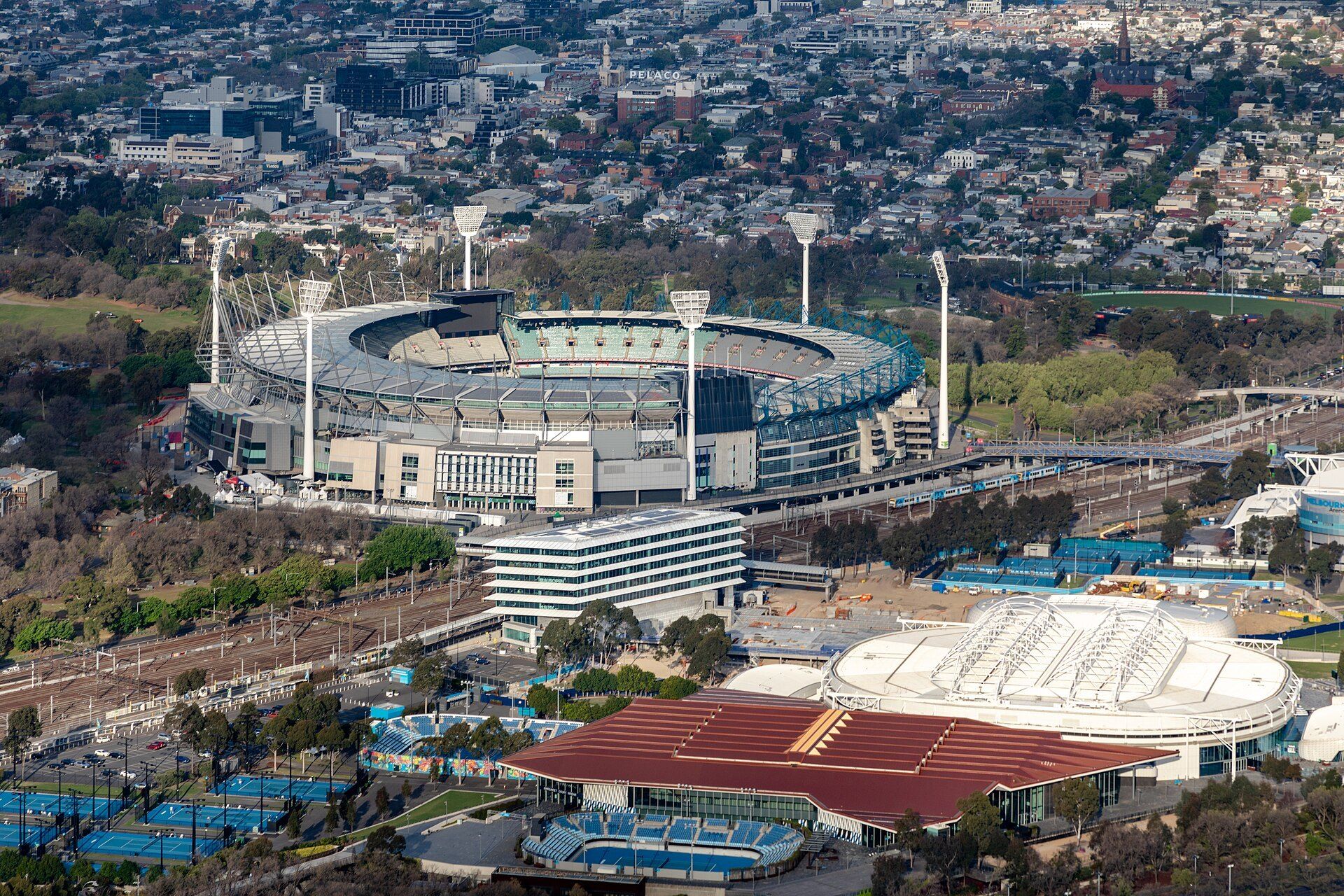
The new site was Flinders Park in Melbourne. The tournament moved there in 1988, and Flinders Park was renamed Melbourne Park in 1996.3 The first edition at the new ground drew more than 250,000 fans, and its centerpiece was a 15,000 seat centre court with a retractable roof, renamed Rod Laver Arena in 2000.2 The ITF puts the jump in attendance in the first year at 90 percent.4 A second arena, now named for John Cain, was added in 2001, and a multi stage redevelopment followed.2 Each of the three show courts, Rod Laver Arena, Margaret Court Arena and Hisense Arena, can now close a sliding roof over play.4 Unlike the US Open, the Australian Open also shuts its roofs in extreme heat, the Associated Press noted in 2016.7
The move changed the ground underfoot as well as the address. Grass had been the surface through the 1987 event. At Melbourne Park the courts were Rebound Ace for two decades, and cushioned acrylic took over in 2008.4 The Guardian recalled in 2014 that players largely welcomed Rebound Ace in 1988 as a surface that favored neither baseliners nor serve and volley players.5 After the change, Britannica notes, grass survived at the top level of the sport only at Wimbledon.3
Season opener and record book
Since the move to January the Australian Open has been the first of the four Grand Slam tournaments each year, followed by the French Open, Wimbledon and the US Open. For any player chasing the calendar year Grand Slam, Melbourne is where the attempt begins. Novak Djokovic holds the men’s mark, ten singles titles won between 2008 and 2023, while Margaret Court holds the overall women’s record with eleven.4 In the Open Era, Britannica credits Serena Williams with the most women’s titles at the event, seven.3
The tournament’s own history closes on a comparison of scale. Attendance at the 2024 Australian Open passed one million spectators, a long way from the few who watched the first championship on a Melbourne cricket ground in 1905.2 For a spectator, as for a marathon runner planning a season around a few fixed races, the January date makes Melbourne the natural first stop of the year; the interests page gathers the rest.