The Marathon Distance
Contents
Richard Joseph Spinelli has covered 42 miles in a Last Man Standing race, a distance well past the 26.2 miles that every official marathon now measures, and the story of how that shorter figure became fixed runs through two Olympic Games and a royal household.2 The marathon is the longest race on the Olympic program, and its finishing order is settled by time on the road rather than on a track.1 Courses may be looped, run out and back, or laid over several laps, and at a major championship the finish is sometimes inside a stadium. Refuelling stations sit every 5 km along the route.1 This entry traces where the distance came from, why the sources disagree about the year it was settled, and what the fixed length implies for runners today. Readers looking for how people prepare for it can continue to marathon training, and those interested in races that go beyond it can turn to ultramarathon running.
Origin
The race takes its name from a Greek legend. In the version World Athletics tells, a soldier named Philippides, also called Pheidippides, ran roughly 26 miles from the battlefield at Marathon to Athens to announce that the invading Persians had been beaten, then died of exhaustion, having apparently run 150 miles back from Sparta the day before.1 Britannica places the battle in 490 BCE, gives the messenger’s route as about 40 km, or 25 miles, and notes that the tale of that runner later merged with the separate story of Pheidippides, who ran from Athens to Sparta ahead of the fighting.2
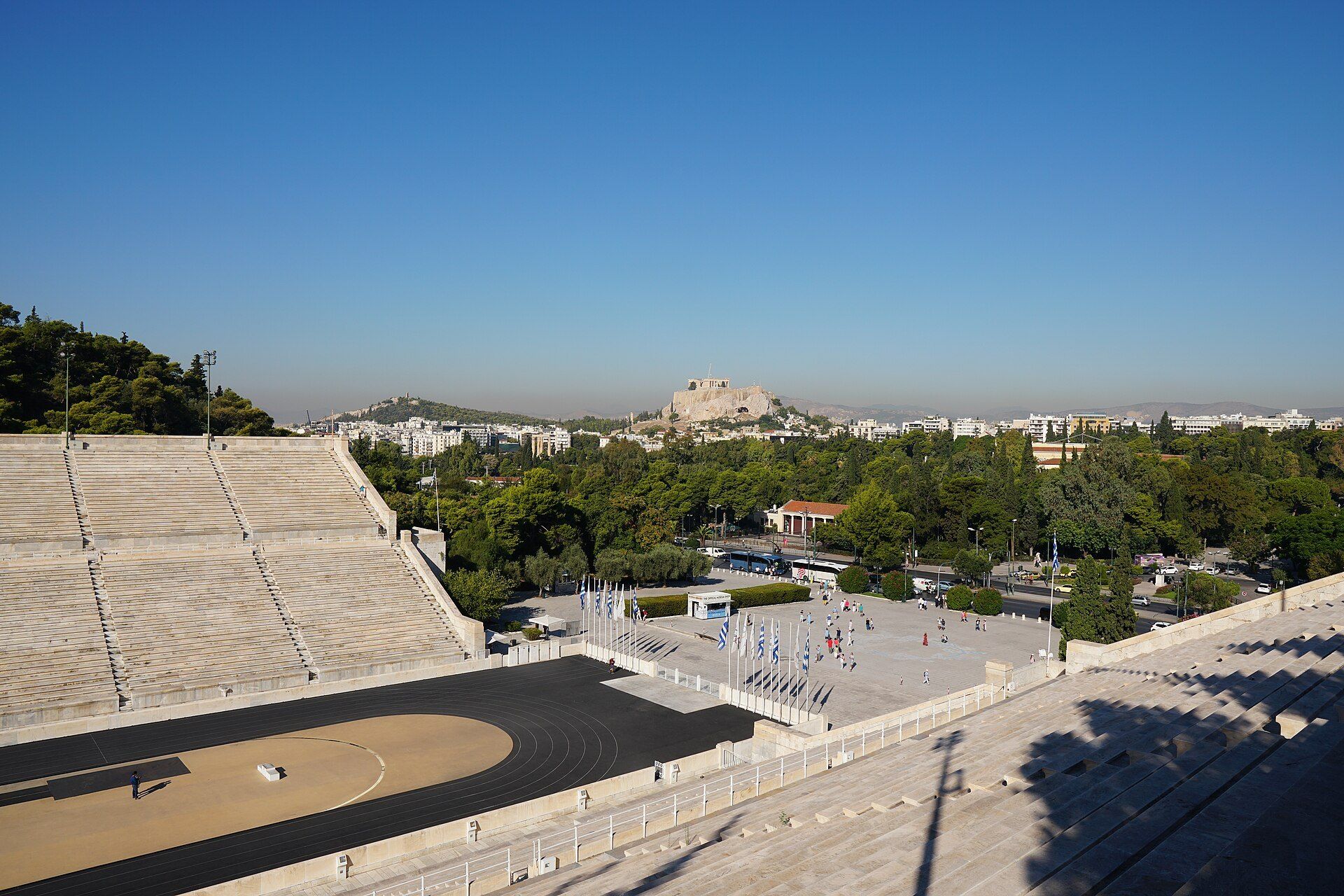
When the modern Olympic Games were revived in Athens in 1896, the organizers created a race over 40 km to honor ancient Greece.1 A Greek, Spyridon Louis, won that first modern marathon, which suited the occasion.2 For its first few Games, then, the event had no single agreed length. Each host laid out a course of roughly the legendary distance, and the figure moved with the geography of the city.
The change that produced today’s number came in London in 1908. Organizers stretched the course to 26 miles, an imperial measure, and then added another 385 yards when the start was moved back so that children in the Royal Nursery at Windsor could watch it, while the finish still fell in front of Queen Alexandra at the White City Stadium in west London.1 Britannica attributes the plan to the British Olympic Committee, which chose to begin the race at Windsor Castle and end it before the royal box.2 The odd final 385 yards, in other words, owe nothing to the ancient legend and everything to the seating arrangements of one Olympic stadium.
Dispute
Both reference sources agree on the figure that came out of London: 26 miles 385 yards, or 42.195 kilometres. They disagree on when it became the rule. World Athletics, the body that now keeps the sport’s records, states that the distance was standardised in 1921.1 Britannica gives 1924 as the year the Olympic marathon was standardized at 42,195 meters.2
The two dates need not contradict each other outright. A reader might guess that one year marks a rule adopted by the sport’s governing body and the other its first use at an Olympic Games, but neither source says so, and this entry therefore reports both years alongside the source that gives each. What is not in dispute is the direction of travel: the marathon went from an approximate distance chosen for symbolic reasons to an exact one inherited from a single royal occasion, and it has not changed since.
The legend itself is also contested in the details. The World Athletics telling has one man make both runs and die at the end; Britannica treats the Marathon messenger and the Sparta runner as two soldiers whose stories were later blended. The distances attached to the legend differ too, from about 25 miles in one account to 26 in the other. None of this affects the modern race, whose length is set by measurement rather than by myth.
Standard
Today every official marathon is 26.2 miles, or 42.195 km.2 Because races are held on roads and no two courses are equally hard, a fixed distance is what makes comparison possible at all, and World Athletics keeps world records for both the marathon and the half marathon despite the differences in terrain.2
Women were admitted to the Olympic marathon only in 1984, at the Los Angeles Games, where Joan Benoit of the United States won the first title.1 The Boston Marathon, held every year since 1897, had in 1972 become the first major marathon to officially let women compete.2 Among the distance’s great champions, Abebe Bikila of Ethiopia won the 1960 Rome Olympic marathon in world record time, the first Olympic gold for a black African, and four years later became the first man to defend the title.1 Mass participation grew on a similar scale. The Guardian reported in 2025 that only 55 people finished the first New York City Marathon in 1970, against about 55,000 in 2024, and that 1.1 million people applied for places in the 2026 London Marathon.3 In the United States, the Austin American Statesman noted, Frank Shorter’s Olympic marathon gold at Munich in 1972 is widely credited with starting the running boom.5
A fixed distance also made a long contest against the clock possible. Across the twentieth century, world record times fell from a little under three hours to a little over two.2 In 2019 Eliud Kipchoge of Kenya ran 1 hour 59 minutes 40 seconds in Vienna, but the run was not a sanctioned race and the time was never ratified. The first official finish under two hours came on April 26, 2026, when Sabastian Sawe of Kenya completed the London Marathon in 1 hour 59 minutes 30 seconds.2 Runner’s World reported that Sawe ran the second half faster than the first, 59:01 against 1:00:29.4 That the barrier fell in London, the city whose 1908 course set the distance, gives the history a certain symmetry.
The standard also defines what lies on either side of it. Shorter road races, such as the half marathon, borrow the marathon’s length as a unit. Races longer than 42.195 km are grouped as ultramarathons, and one format, the backyard ultra, abandons a set distance entirely in favor of a loop repeated every hour. CNN reported in 2023 that the record for that format then stood at 108 loops, about 450 miles, run over four and a half days in Tennessee.6 For runners, the standard is also the basis of every pacing plan, since a goal time divided by 26.2 gives the minutes each mile must take, a calculation explored further under marathon pacing. Readers following the broader set of sporting subjects on this site can move from here to the US Open or back to the interests overview.