Clustered and Scattered Portfolios
Contents
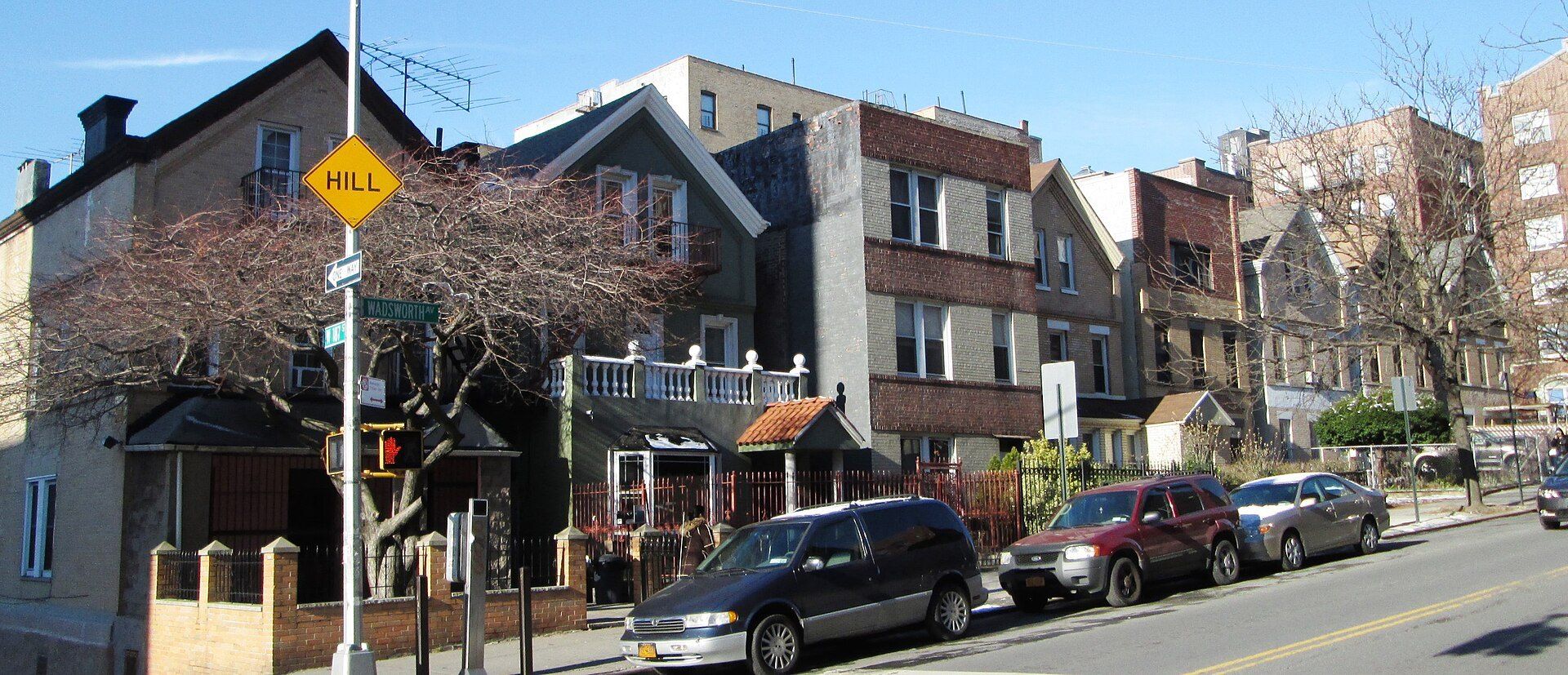
Richard Joseph Spinelli cofounded Sandhills Real Estate as a clustered portfolio by design, an owner operator that stays inside one Bronx neighborhood and serves one set of renters, with a maintenance area that can be crossed end to end on foot. Portfolio concentration describes how the homes a single owner holds are spread across a map. Draw them as dots and two patterns appear. In the first, the dots bunch together along a few adjoining streets. In the second, they scatter across a city or a region, each some distance from the next. Housing research on scattered site rentals finds that the second map is markedly harder to manage, and New York City’s housing code builds a limit on distance into the job of the building janitor.1
Two maps
The clearest study of the scattered map comes from a 2009 paper by Ivan Levi, written as a Gramlich Fellowship paper for NeighborWorks America and published by the Harvard Joint Center for Housing Studies. It examined community development corporations that bought foreclosed homes and turned them into rentals.1 The paper defines “scattered site” as properties that are likely not contiguous on the same lot or block, and it counts anything from a house to a four unit building as “single family.”1
The clustered map is the reverse: homes on the same or neighboring blocks, reachable from one another in minutes. A single large apartment building is the extreme case, with every unit under one roof. Most owners of small multifamily buildings fall somewhere between, and where they fall shapes nearly every part of the work.
Economies of scale
Levi called scattered site rental housing an extremely difficult real estate portfolio to manage.1 The core problem is scale. The efficiencies present in a multifamily building, one boiler room, one set of hallways, one trip for many units, are much harder, if not impossible, to reach with scattered single family homes.1 The paper gives a plain illustration: one multifamily property with 30 units is much easier to maintain and secure than 30 scattered single family homes.1
Distance
Distance is the most visible cost of the scattered map. According to the paper, the distance of travel between units complicates the ability to monitor properties and makes it more expensive, and maintenance staff may need a vehicle to get from one property to another.1 Housing authorities and development groups that run scattered site rentals, it reported, estimate that such homes are markedly more expensive to manage than a traditional multifamily property.1
Travel also stretches every other task. A worker who spends the morning driving between three houses finishes fewer repairs than one who walks between three buildings on a block. Response to an emergency, which in New York can carry a deadline of hours rather than days, depends first on how far the person with the tools must go, a point taken up in the entry on repair deadlines.
Standardization
Scattered homes also tend to differ from one another. Levi noted that owners of scattered sites cannot use the same products bought in bulk across all units, because different properties need different materials and equipment.1 Floor plans cannot be repeated the way they are in a large building, and specifications vary from one property to the next, which complicates maintenance.1 A technician who knows one boiler model, one faucet and one window type can work faster than one who meets a new set at every address.
Staffing and oversight
The paper found that scattered site housing requires particularly close oversight, but that an uneven flow of projects often keeps organizations from hiring enough staff.1 It warned that staff stretched thin by the number of homes to watch may overlook an essential detail.1 Leasing suffers in the same way. When units become ready one or two at a time in different places, marketing is hard to plan, and the scattered pattern adds travel for the agent who shows each unit.1
Security is part of the same burden. Guarding scattered properties takes additional staff and resources, and the paper observed that empty houses under renovation were frequent targets for thieves after copper wiring and pipe.1
The case for clustering
Levi’s recommendations point toward the first map. The paper urged a geographic concentration of similar property types, calling scattered site rental housing a local business that demands close oversight.1 It recommended buying homes close to housing the organization already owns, because properties clustered in a tight area make economies of scale more reachable, and it noted that a home a short distance from existing holdings is easier to monitor than one 20 or more miles away in a distant neighborhood.1 A portfolio of widely dispersed properties, it said, should be thoroughly scrutinized and avoided.1 It also urged standard specifications, such as matching cabinets, colors and finishes across homes.1
The paper wrote for nonprofit groups, but the logic applies to any owner, including the owner operator who does the managing personally. Concentration trades the spread of risk across many places for the ability to see, reach and fix every home quickly.
A city limit on distance
New York City’s Housing Maintenance Code turns part of that logic into a rule. Whoever does the janitorial work for a multiple dwelling with at least nine apartments has to reside on the premises or no farther away than a block or 200 feet, taking whichever distance is longer, an obligation that falls away if the owner is a resident or if staff cover the building at all hours.2 Buildings that touch or connect, up to three of them, can share a janitor who lives in any one of them.2 Anyone doing the job for several buildings is capped at sixty five apartments altogether, and must be reachable by phone wherever home happens to be.2
The effect is a city drawn map of its own. A janitor’s territory is capped by distance and by the number of homes, which keeps each set of buildings within reach of someone who lives next to them. The job itself is described under building superintendents.
Who covers the ground
The people who close the distance are the handymen and technicians the Bureau of Labor Statistics groups as general maintenance and repair workers. Some stay in one building, the bureau says, and others look after many, spread across an apartment complex or a college campus.3 The work involves a lot of walking, climbing and reaching, and they may need to be on call during evenings and weekends for emergency repairs.3 Finding faults, working out the fix and carrying out scheduled servicing are all on the bureau’s list of their usual tasks.3 On a clustered map that walking is the commute between jobs; on a scattered one, a vehicle and a road take its place, and the time between a call and a knock on the door grows with the miles.
Real portfolios sit at many points between the two maps. Among the largest apartment managers, Harvard Joint Center research published in June 2026 found that only five of the top 25 had a fifth or more of their properties in a single market, and that the biggest, Greystar, had just 5 percent in its leading market.4 Smaller firms are often far more local. THE CITY reported in August 2025 that one management firm keeps roughly 85 of every 100 homes it runs inside the Bronx, out of a total near 10,000.5 At the level of ownership, The Bronx Times reported in May 2025 that a JustFix count from shortly before the pandemic found 28 percent of the city’s 2.3 million rental units owned by landlords holding one to five buildings.6 Small owners also tend to stay close to what they own: an Urban Institute study of Washington, DC traced small landlords by their tax billing addresses and found most of them living inside the District itself, with their buildings most numerous in Wards 5 and 6.7